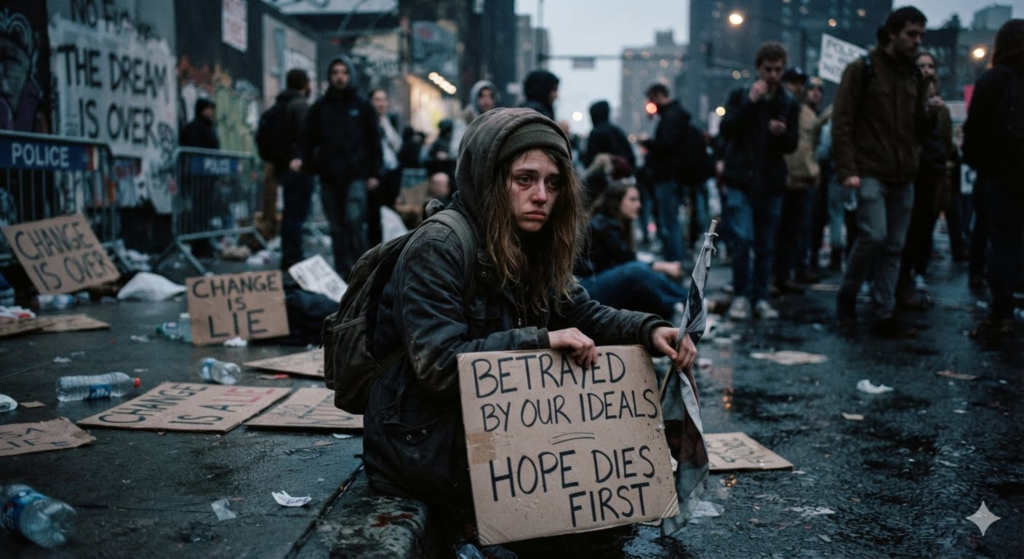
On July 1st, I was talking to a fellow neighbor about the general mood/feeling in our group and society in general, and I brought up the term disillusionment without ever considering it previously. Of course, I began to fixate on the idea as it’s something I have noticed for sometime with certain aspects of society, but didn’t key in on it until later that evening. Because, I was previously preoccupied with making my latest Youtube video, I did not re-investigate the idea till the following morning.
To my surprise it was just another puzzle piece in the overall picture of what I have been working on; in this website. There is one thing you have to understand; almost everything I have discussed in the website is content that came from university scholars, professors, economists, historians, and highly related historical figures. Even in this blog, if you were to investigate the following terms yourself, it unravels a complex web of understanding and utter clarification of what we are dealing with right now in our time. This is both the delightfully enlightening and frustratingly tragic rabbit hole I have found myself in!
Apathy: America’s democratic values and Constitution has been under attack by the Trump Administration since 2015. In the past couple years we have had multiple major events that should have united the democratic party and the country. But, this yielded a few half-hearted single day protests. At least for us liberals, there are many of us who are completely aggravated by the lack of participation. Many who work in the democratic party seem both puzzled and fraught with trying to engage new and existing voters in the democratic party. More in this in a little bit.
When we stop and think about it there is a massive collision that just converged in the past couple of years. We are in fact still a biological entity Although we have evolved extremely quickly in our technologies, especially in the past one hundred years, our minds are not able to keep up and process these advancements when we add the complexities of human behavior, traditions and ideologies. And at least for a few, I can make a case that some are still stuck in Cro-Magnon days. Aside from the advanced technologies we have, the nations crippling political divide and the constant financial struggles of Americans. All these factors took time to come to a slow rolling boil, the convergence between technology, income inequality and increased political tension for the past 50 years have seriously turned the fire up, and we are now witnessing boil over. See my blog on The Wealth Pump and the page on Earth: a living biosphere for additional in depth discussion about what is unfolding.
If it seems like there is apathy and disillusionment in the air. You are absolutely correct. Americans in general are exhausted by the bullshit politics, corporate news viewership battle and social media click bait. America’s hostility have been constantly evolving since the civil war and it is thru time, advancement in technology and culture these conflicting ideologies have expanded (online and data protection, surveillance state, crypto ect..) Although, most politics that was relevant then are still just as contentious as it is today.
In short America has pulled back mentally and is concentrating on mere financial survival. This is called late-stage Interregnum just prior to collapse. Below is a brief discussion with AI
**An unfortunate incident occurred: Towards the end of a lengthy discussion with AI on my cell phone, I thought I saved the entire conversation only to find out after I navigated away the discussion was lost. I had to briefly start over and rebuild the discussion for context. It really does lose a lot of the feel of the in depth conversation between philosophy, psychology and economics.
Me: we were discussing disillusionment, The quiet period right before collapse of some civilizations. The Interregnum (Antonio Gransci) and outrage industrial complex
AI: The phase you are describing captures the precise moment a society’s foundational stories stop working, yet no new story has emerged to replace them. This historical and psychological crossroads is often defined by deep disillusionment, institutional paralysis, and heightened social friction.
Gramsci’s Interregnum
The Italian philosopher Antonio Gramsci famously defined this specific, anxious waiting period in his Prison Notebooks.
- The Core Crisis: He wrote, “The crisis consists precisely in the fact that the old is dying and the new cannot be born.”
- Morbid Symptoms: Gramsci warned that during this gap—the interregnum—a great variety of “morbid symptoms” appear.
- Authority Loss: The ruling class loses its consensus, meaning it no longer leads culturally, but merely rules through pure force.
Me: How does the Gramsci’s Interregnum relate to today?
Gramsci’s concept of the interregnum is highly relevant today. Modern political scientists, sociologists, and economists frequently cite his work to explain why contemporary global systems feel incredibly unstable, yet unyielding to change.
Thinkers like Nancy Fraser have directly used Gramsci’s framing to dissect current events in works like The Old Is Dying and the New Cannot Be Born. The interregnum manifests across four major dimensions of modern society:
1. The Crisis of Neoliberalism
- The “Old” Dying: The global economic model established in the late 20th century—characterized by hyper-globalization, deregulation, and free-market capitalism—lost its widespread ideological legitimacy after the 2008 financial crisis.
- The “New” Lacking: No single, cohesive economic alternative has replaced it. Instead, the world fluctuates between attempts to patch up the old system, rising protectionism, and fragmented trade wars.
2. Political Polarization and the “Time of Monsters”
- Decline of the Center: Traditional, moderate political parties that stabilized Western democracies for decades have seen their voter bases fracture.
- Morbid Symptoms: Gramsci noted that a vacuum of authority breeds “monsters”. Today, this is seen in the global surge of populist movements, extreme political polarization, and a growing public openness to authoritarian governance because traditional institutions seem entirely paralyzed.
3. Fragmentation of the Geopolitical Order
- The “Old” Dying: The “Pax Americana” and the Western-led liberal international order that governed global politics since World War II are actively fracturing.
- The “New” Lacking: A clear successor framework has not yet been established. We are in a messy, multi-polar gray zone where international bodies like the UN are frequently gridlocked, and localized regional conflicts flare up without any global superpower successfully enforcing stability.
4. Technosphere and Information Chaos
- Decline of Shared Reality: The legacy media gatekeepers that once established a “cultural hegemony” have lost their monopoly on truth.
- Morbid Symptoms: Instead of a more democratic, open society, the digital vacuum has generated a highly fragmented information landscape. Algorithms maximize outrage, driving widespread misinformation, echo chambers, and institutional distrust.
Mapping Today’s Interregnum
| Structural Pillar | The “Dying” Old Order | The Modern “Morbid Symptoms” | The Unborn Future |
|---|---|---|---|
| Economics | Unregulated Global Free Markets | Wealth inequality, severe inflation, supply chain vulnerabilities | Sustainable, equitable distribution systems |
| Politics | Institutional consensus & centrist parties | Hyper-polarization, populism, democratic backsliding | New participatory democratic frameworks |
| Geopolitics | Uni-polar Western-led alliance (LIO) | Regional warfare, gridlocked global diplomacy | A stable, collaborative multi-polar order |
Ultimately, Gramsci’s theory reminds us that our current era of compounding crises is a predictable transition phase. The old ways of running the world no longer command consent, but the alternative has not yet gathered enough collective power to take hold.
Me: How does disillusionment relate to today?
AI: Disillusionment is the defining psychological state of today’s interregnum. If Gramsci’s concept describes the breaking down of societal structures, disillusionment is how everyday people feel that collapse internally.
When people realize that the “promises” of modern society—such as social mobility, political representation, and institutional stability—are no longer functioning, they experience a profound loss of illusion. In modern society, this disillusionment drives major trends across politics, economics, and culture:
1. Political Cynicism and “Systemic Ghosting”
The most direct manifestation of modern disillusionment is the widespread collapse of trust in democratic institutions.
- Voter Apathy: Rather than actively fighting the system, massive blocks of citizens—particularly young voters—are withdrawing from traditional politics altogether. Globally, electoral participation rates have consistently declined, driven by a fatalistic belief that the system is entirely controlled by special interests and can no longer solve existential threats.
- Democratic Backsliding: Disillusionment with the performance of moderate democracies has caused a global trend of democratic anxiety. This makes populations vulnerable to populists who promise to burn down the old, dysfunctional institutions.
2. Economic Defatigation and Cultural Shifts
Economic disillusionment occurs when the traditional milestones of adulthood (such as affordable housing, stable careers, and retirement) feel statistically impossible for the average worker.
- The Death of “Hustle Culture”: For years, cultural hegemony dictated that hard work within the system guaranteed success. Today, widespread disillusionment has caused people to reject this narrative. It has birthed major cultural trends like “slow living”, “quiet quitting,” and a focus on an “uncurated life” over polished corporate expectations.
- The “Vibecession”: Even when macroeconomic data indicates growth, public sentiment remains deeply pessimistic. This mismatch exists because people are entirely disillusioned by systemic wealth inequality and the persistent rise in the cost of living.
3. Institutional Distrust and Alternative Realities
People have become profoundly disillusioned by traditional gatekeepers of truth, including the legacy press, medical institutions, and corporate leadership.
- The Rise of Parallel Systems: Because people no longer trust centralized authority to protect them, they seek alternative networks. This fuels the rise of decentralized finance (crypto), alternative health movements, and independent media ecosystems.
- Polarization: Psychological research demonstrates that disillusionment triggers a desperate search for meaning. When people lose faith in the societal center, they frequently double down on extreme ideologies, driving the severe political polarization witnessed today.
The Danger vs. The Hope of Disillusionment
Disillusionment is a double-edged sword. It can lead to two entirely different societal paths: [1]
                      ┌──> Fatalism & Nihilism ──> Political Apathy & Social Decay
                      │
[DISILLUSIONMENT] ────┤
                      │
                      └──> Radical Realism ──────> Clear-Eyed Activism & Innovation
- The Negative Path (Nihilism): If disillusionment curdles into fatalism, it results in societal paralysis. People give up, drop out of civic life, and allow the “morbid symptoms” of the interregnum to fester unchallenged.
- The Positive Path (Radical Realism): Stripped of its negative connotation, literal dis-illusionment means the removal of an illusion. Gramsci argued that the key to surviving an interregnum is to live a life entirely without illusions, without allowing yourself to become cynical. When old myths die, it creates the precise cultural space necessary for artists, thinkers, and innovators to imagine entirely new ways to live and govern.
Me: How does The Quiet Period relate to today?
AI: In macroeconomic history, “The Quiet Period” refers to the remarkable era of financial stability in the United States between 1934 and roughly 1980. Following the devastating bank runs of the Great Depression, the Glass-Steagall Act instituted rigid regulations, banned banks from speculative stock trading, and created the Federal Deposit Insurance Corporation (FDIC). For nearly half a century, banking became boring, predictable, and remarkably safe—commercial bank failures virtually vanished.
When connected to Gramsci’s Interregnum and our modern psychological state of disillusionment, The Quiet Period represents the lost “Old Order” that today’s world is mourning but cannot recreate.
1. The Myth of the “Default” State
- The Illusion: For generations, Western societies treated the stability, middle-class expansion, and steady institutional trust of the mid-20th century as the natural, baseline state of modern democracy and capitalism.
- The Reality Exposed Today: Looking back through a Gramscian lens, The Quiet Period was an anomaly. It was a heavily engineered, temporary truce between capital, labor, and massive government regulation. Today’s ongoing instability is not a sudden glitch; it is a return to the historical norm of unregulated capitalism, which inherently fluctuates between rapid growth and deep crisis.
2. The Root of Modern Disillusionment
- The Broken Promise: Modern disillusionment is a direct byproduct of the contrast between “The Quiet Period” and today’s volatile landscape. Older generations grew up under the assumption that boring institutional compliance guaranteed a house, a steady career, and financial security.
- The Modern Betrayal: Starting with the deregulation wave of the 1980s and cementing with the 2008 financial crisis, that quiet social contract was dismantled. Young adults today experience deep cynicism because they are being judged by the economic metrics of The Quiet Period, while being forced to navigate a precarious, gig-driven, hyper-inflated economy.
3. Nostalgia as a “Morbid Symptom”
- Weaponized Nostalgia: In his Prison Notebooks, Gramsci noted that during an interregnum, the collapse of an old hegemony leads to dangerous political extremes. Today, because the “new cannot yet be born,” society is trapped in cycles of profound nostalgia.
- The Trap: Populist movements on both the left and right successfully weaponize the memory of The Quiet Period (e.g., promising to bring back industrial factory monopolies or mid-century single-income household stability). However, these promises are illusions; you cannot recreate mid-century economic containment in a hyper-digitized, interconnected, globalized world.
The Contrast: Then vs. Now
| Dimension | The Quiet Period (1934–1980) | The Modern Interregnum (Today) |
|---|---|---|
| Banking & Finance | Low-risk, heavily restricted commercial banking. | High-frequency trading, shadow banking, crypto volatility. |
| Institutional Trust | Widespread faith in regulatory guardrails like the FDIC. | Widespread cynicism; belief that systems favor corporate elites. |
| Social Mobilization | Predictable pathways to middle-class security. | Disillusionment, “quiet quitting,” and economic paralysis. |
Ultimately, The Quiet Period shows us exactly what we are grieving. The current global chaos feels so jarring because society spent decades believing that stability was a permanent achievement, rather than a temporary shield that has now completely worn away.
The Quiet Period Before Collapse
In systemic collapse theory, the “quiet period” or the lull before a civilization’s breakdown is a well-documented phenomenon.
- Delayed Feedback: Complex systems (like economies or empires) often show a delay between environmental or economic degradation and actual societal collapse.
- Illusion of Stability: On the surface, institutions look grand and functional, but internally, they have lost their resilience and flexibility.
- The Cassandra Dilemma: Public intellectuals and whistleblowers warn of structural failure, but the broader public remains paralyzed by disillusionment or distracted by internal fighting.
The Outrage Industrial Complex
In modern contexts, the interregnum is heavily capitalized on by media and tech algorithms, creating what is known as the outrage industrial complex.
- Monetizing Friction: When a society loses its shared truth, media ecosystems maximize profits by feeding tribalism and anger.
- Stalling Progress: Instead of building the “new” world Gramsci spoke of, public energy is trapped in a loop of constant, exhausting reaction to digital provocations.
- Distraction from Core Decay: Hyper-focus on cultural grievances masks the deeper, systemic physical and economic vulnerabilities of the civilization.
Systemic collapse theory is a multidisciplinary framework that explains how complex societies, ecosystems, or economic structures experience rapid, compounding failure when their internal mechanisms break down. Instead of a single external event destroying a system, collapse occurs because the system’s own interconnectedness causes minor failures to cascade out of control.
When integrated with Gramsci’s Interregnum, our modern disillusionment, and the loss of the economic “Quiet Period,” systemic collapse theory provides the ultimate analytical endpoint. It describes what happens when the “morbid symptoms” of an era are left unaddressed for too long.
Key Pillars of Systemic Collapse
1. Hyper-Complexity and Diminishing Returns
- The Mechanism: Pioneered by anthropologist Joseph Tainter in his foundational work The Collapse of Complex Societies, this principle states that societies constantly add layers of complexity (e.g., more bureaucracy, specialized infrastructure, longer supply chains) to solve problems.
- The Breaking Point: Eventually, the energy and wealth required to maintain this massive complexity outweigh the benefits it provides. The society hits a point of diminishing returns, rendering it incredibly fragile and highly vulnerable to even minor external shocks.
2. Synchronous Failure (The Cascading Effect)
- The Mechanism: Modern systems (such as food supply chains, global financial markets, and energy grids) are hyper-optimized for efficiency rather than resilience.
- The Breaking Point: Because every component relies heavily on the others, a shock in one sector immediately triggers a domino effect across unrelated sectors. For instance, a localized cyberattack or climate shock can simultaneously cripple shipping lanes, spike global food prices, trigger civil unrest, and crash financial markets.
3. Loss of Adaptive Capacity
- The Mechanism: Systems survive by adapting. However, when a society’s institutions lose the trust of their populace (as seen in modern disillusionment), they lose their capacity to mobilize collective action.
- The Breaking Point: The system’s elites become entirely hyper-focused on preserving their own dwindling power rather than solving systemic structural failures. This dynamic mirrors the Gramscian gridlock where the old order refuses to yield, effectively blocking necessary structural reforms.
Connecting the Four Concepts: The Modern Path to Collapse
The four ideas you have explored form a chronological and structural map of contemporary global instability:
- The Quiet Period (The Lost Anchor): Society established a highly regulated, temporary illusion of permanent stability and institutional trust.
- Disillusionment (The Psychological Catalyst): The deregulation of that stability shattered the social contract. Citizens realized the system no longer worked for them, leading to widespread civic withdrawal and institutional distrust.
- The Interregnum (The Structural Gridlock): Distrust paralyzed the political center. The old order lost its legitimacy but clung to power through coercion, creating a volatile gray zone overflowing with “morbid symptoms” (populism, polarization, and geopolitical fragmentation).
- Systemic Collapse Theory (The Final Breaking Point): If the interregnum fails to birth a new, resilient system, the compounding weight of these unresolved morbid symptoms—exacerbated by hyper-complexity—triggers a rapid, cascading structural failure.
Collapse vs. Transformation
Systemic collapse theorists emphasize that collapse is rarely an instant, apocalyptic event. Instead, it is typically a decades-long process of gradual decay, public withdrawal, and fracturing infrastructure.
Crucially, collapse theory does not dictate an inevitably grim future. Just as Gramsci noted that the end of an illusion allows a new future to be born, collapse theory argues that the breakdown of a hyper-complex, unsustainable system is often the exact physical requirement needed to decentralize power, clear away bureaucratic rot, and build localized, resilient, and human-centric societies.
Me: I want to investigate is the period right now in American society in relation to everything we discussed, as well as other complex subjects such as Karl Marx, Wealth Pump, Cliodynamics and the Club of Rome theory. Are we in the disillusionment phase, The Interregnum or Systemic Collapse Theory?
AI: When evaluating the current state of American society through the lenses of Karl Marx, Peter Turchin’s Cliodynamics, and the Club of Rome, the United States is firmly anchored in the mature, late-stage Interregnum, while actively experiencing the opening, non-linear skirmishes of a systemic collapse.
We have passed the point where disillusionment is a mere psychological phase; it has successfully crystallized into structural fractures. To map exactly where America stands, we must synthesize these dense frameworks to see how they intersect in real time.
1. Karl Marx: The Contradiction of the Late Capitalist Superstructure
For Marx, a society enters a pre-revolutionary or collapse phase when its relations of production (economic structures, ownership, laws) become a fetter on its productive forces (technology, labor capacity).
- The American Context: In the US today, hyper-automation, AI, and advanced logistics should theoretically liberate human labor and dramatically drive down the cost of living. Instead, late-stage capitalist ownership frameworks use artificial scarcity, intellectual property monopolies, and financialization to hoard these efficiency gains at the top.
- The Result: This alienates the modern proletariat (the working and precariously employed middle class) and turns technology into an instrument of surveillance and labor exploitation rather than liberation.
2. Cliodynamics & The Wealth Pump: The “End Times” Cycle
Peter Turchin’s Cliodynamics (the mathematical modeling of historical cycles) provides the structural diagnosis for why the Quiet Period ended. Turchin argues that societies inevitably build a Wealth Pump—a mechanism that siphons economic rewards from the working majority to the elite minority. In America, this pump has been running continuously since the late 1970s, leading to two catastrophic structural conditions:
- Popular Immiseration: The stagnation of real wages alongside the skyrocketing costs of core necessities (housing, healthcare, education), resulting in a profound societal exhaustion. [1, 2, 3]
- Elite Overproduction: The wealth pump creates an excess of affluent, highly educated, ambitious individuals competing for a stagnant number of top-tier power positions (political offices, corporate board seats, cultural curator roles). [1, 2]
According to Turchin’s framework, America is in the volatile “End Times” zone of this cycle. The surplus of frustrated “elite aspirants” have become counter-elites, actively exploiting popular working-class disillusionment to attack established institutional norms.
3. The Club of Rome: The Material Wall
While Cliodynamics tracks social and political data, the Club of Rome’s The Limits to Growth (and its continuous 21st-century updates) tracks physical data: food, resources, industrial output, and pollution. Its baseline “Standard Run” computer model long predicted that global industrial expansion would hit a peak and begin an uncontrollable contraction.
- The American Context: The US is attempting to maintain an economic model predicated on infinite growth while running headfirst into the physical limits of ecological breakdown, resource depletion, and infrastructure decay.
- The Feedback Loop: When physical growth stalls or becomes too expensive due to climate shocks and ecological strain, elites can no longer expand the total pie. To maintain their wealth, they must aggressively extract it from the lower classes, hyper-charging Turchin’s wealth pump and escalating social unrest.
Diagnosing the Present: Where Are We?
To determine exactly where American society sits, we must separate the psychological, structural, and material layers of the crisis:
                  [ STRATIFIED GEOMETRY OF THE CURRENT CRISIS ]

   PSYCHOLOGICAL LEVEL: ──> [ Disillusionment ] ──> COMPLETED
                            (Public trust has already evaporated)
                                    │
                                    ▼
   STRUCTURAL LEVEL:    ──> [ The Interregnum ] ──> CURRENT LIVING REALITY
                            (Political stalemate, "Monsters" rule the airwaves)
                                    │
                                    ▼
   MATERIAL LEVEL:      ──> [ Systemic Collapse] ──> INITIAL PHASES UNFOLDING
                            (Non-linear cascading failures in systems)
1. The Disillusionment Phase: Completed & Institutionalized
Disillusionment is no longer a temporary feeling; it is the permanent baseline of American culture. The public has fully absorbed the reality that the institutional metrics of the Quiet Period are gone and never coming back. It has transformed from an emotional reaction into an active economic strategy—manifesting as the total rejection of corporate hustle culture, dropping out of traditional civic participation, and the systemic embrace of decentralized, alternative information parallel realities.
2. The Interregnum: Our Political and Cultural Reality
America is structurally trapped in the deep trenches of The Interregnum. The old neoliberal hegemony has completely lost its moral authority and popular consent, yet no alternative framework can consolidate power.
- The Morbid Symptoms: We are living in what Gramsci called the “time of monsters.” The political sphere is entirely deadlocked. Because the stakes of political defeat are now viewed as existential by both elite factions, the state increasingly relies on polarization and legal warfare rather than democratic consensus to maintain stability.
3. Systemic Collapse Theory: The Micro-Cascades Have Begun
We are not in a Hollywood-style, overnight apocalyptic collapse, but we are experiencing the initial, non-linear phases of systemic collapse. Under Joseph Tainter’s definition, America is experiencing cascading infrastructure failures.
- The Evidence: The compounding crises of recent years—where supply chain shocks, persistent inflation, housing instability, failing electrical grids, a fracturing public health landscape, and climate-induced disasters strike simultaneously—are classic symptoms of synchronous failure. The bureaucracy required to patch these holes has reached a point of diminishing returns; fixing one crisis now directly starves the resources needed to prevent another.
Summary
The United States has moved past the psychological buffer of disillusionment. Americans are actively living inside a hyper-polarized, gridlocked Gramscian Interregnum, while the physical and economic scaffolding of the society is undergoing the opening, cascading chapters of structural systemic collapse. The core question for this century is no longer if the current system can be saved, but whether the counter-elites and the public can shut down the wealth pump to manage a peaceful transition before the material limits of the system force a chaotic breakdown.
Back to my commentary:
As you can see several if not most of these theories are colliding in a monumental fact based orgy of historical documentation. Americans are literally tired, battered, confused and retreated to their individual corners or back deeper in the confines of their closest secure bubble’s. The worker and poor is just trying to survive one more day. The wealthy is trying to wring the last drop of profit from a dry rag, and our government officials are struggling to maintain power.
For the normal everyday person. Our politics are spread almost in parabola mirror image of the divide in wealth inequality. There are a few traditionalists who are desperately trying to hold onto centrist positions when logic dictates those days are gone the way of the dodo (The Quiet Period.) The sentence I brought up earlier: many who work in the democratic party seem both puzzled and fraught with trying to engage new voters in the democratic party. This can easily be summed up as many voters-on both sides have given up (again as described everywhere above.) But, at least for the left, we have endured even more wealth inequality as well as unjust rule and we are sick and tired of the typical weak posturing of the democratic party especially when they talk centrist politics and bipartisanship. The goal posts have been moved consistently for over 50 years, and for black people 250 years! 38% of Americans (myself included) want a more aggressive socialist movement as seen in several highly contested races in both New York, Washington, Michigan, Colorado and DC.
*Side note-Antonio Gramsci was imprisoned by Benito Mussolini’s fascist regime in November 1926 for his political subversion, anti-fascist journalism, and leadership of the Italian Communist Party.
Mussolini’s government utilized the turmoil of a supposed assassination attempt on the dictator as a pretext to outlaw opposition parties and arrest communist leaders. Despite his active parliamentary immunity, Gramsci was arrested, charged with treason, and eventually sentenced to 20 years in prison in 1928. The fascist prosecutor famously summarized the regime’s motive by stating, “We must stop this brain from working for 20 years.”
While serving his sentence in Turi, Gramsci endured harsh, restrictive conditions and failing health, prompting him to secretly draft his famous Prison Notebooks, which profoundly shaped 20th-century political theory.
**Another side note-A scientific theory is a thoroughly tested, highly reliable explanations of the natural world. It synthesizes a vast body of facts, laws, predictions, and tested hypotheses.
Core Components
- Evidence-Based: Backed by extensive, rigorous empirical data.
- Predictive Power: Allows scientists to forecast yet-unobserved phenomena.
- Falsifiable: Must be framed so it can be proven wrong if conflicting evidence emerges.
- Dynamic: Subject to revision or refinement if new, superior data is discovered.
Key Distinctions
- Theory vs. Fact: Facts are basic observations; theories explain why and how those observations happen.
- Theory vs. Law: Laws describe what happens mechanically (often mathematically); theories explain the underlying mechanism.
- Theory vs. Hypothesis: Hypotheses are tentative, untested guesses; theories are mature, verified frameworks.
Leave a Reply