Chances are you probably went to the market this week to get groceries. Did you cringe when you look at the prices? Did you wonder if you’ll have enough money to get you through the week? If so, your not alone, but you are a peasant. Today’s Facts:

Key Recent Profit Trends (2025-2026):
- Record Highs: Corporate profits have continued to grow, marking one of the most profitable periods for U.S. corporations, with a nearly 10% annual growth in 2023 and sustained growth in 2024 and 2025.
- U.S. corporate profits have reached record highs, with Q4 2025 reaching ($4.352) trillion, up from ($4.105) trillion in Q3 2025. This surge is driven by strong performance in retail, wholesale trade, construction, manufacturing, and AI-related tech, allowing companies to maintain robust margins by passing higher costs onto consumers.
- As of early 2026, the trend in the United States shows a widening income and wealth gap, often described as a K-shaped recovery or economy, where the wealthy have experienced rapid gains while working-class income growth has been significantly slower or stagnant. [1, 2, 3, 4, 5]
- Growing Wealth Gap: Richest Americans (top 1%) have seen their wealth grow over 139 times faster than the bottom 20% since 1979, with that trend accelerating through 2024 and 2025.
- Cost of Living: Inflation for essentials (housing, food, healthcare) disproportionately impacts working-class households.
- As of late 2025/early 2026, the average annual salary for working Americans is approximately $65,000 to $66,600. The median salary, which is often considered a more accurate reflection for most workers, is around $59,000–$62,000. Income varies significantly by age, gender, and location, with peak earnings typically occurring between ages 35 and 54.
$59-$62K is the average across the entire working class. Question: do you make this much per year? The reality: most of these big corporations make enough end of year profits to equivalent winning the lottery! Let that sink in! Question: for the “MAGA” guys and gals, I’m talking about the regular Joe/Jane that voted for Trump. You more than likely broke like the rest of us. Does it appear like Trump is Making America Great for YOU? Definitely not!
The top 1% officially have more money than the whole middle class
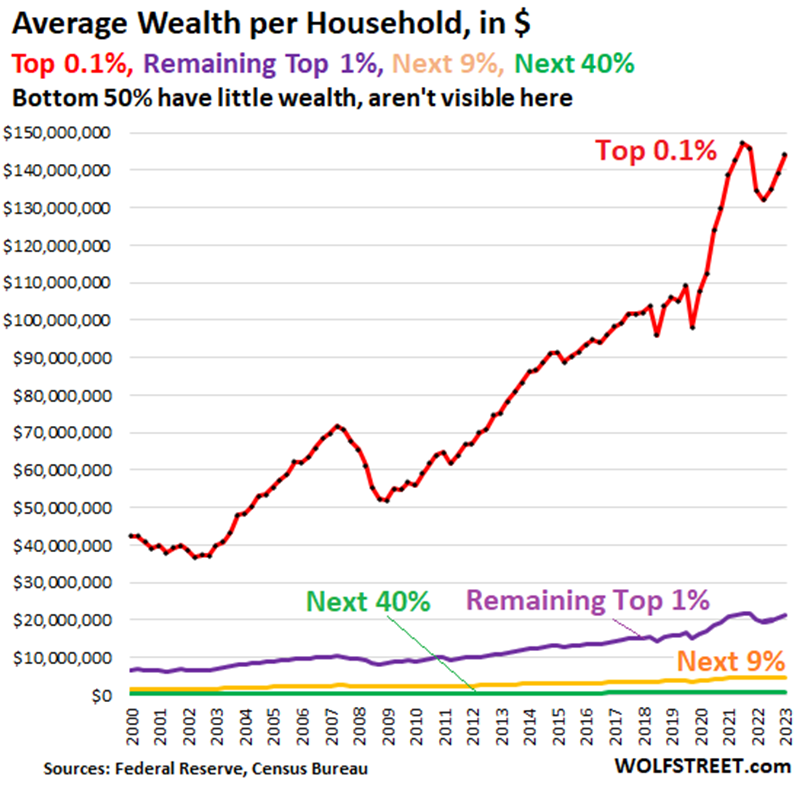
First, I could have used many other charts from other reputable sources showing a more detailed trend that is unfolding but, because certain uneducated people will dismiss these organizations as politically motivated or left leaning, I decided to use the one from a business driven news agency (the one rich people like to read) and the other from the government branch over all things financial. The upper chart was from a Business Insider 2021 report, I do not know how I missed it when I was writing my book, but it is clear statement.
The one (1) percent of the wealthy have more wealth than the entire working class and this was in 2021 and is even worse now, five years later. The Lower chart is more recent and from the Federal Reserve and Census Bureau. Also a very clear statement. The area between the yellow and green line represents 90% of Americans! See the green line on the bottom, it us most likely you and I. What the graph does not show is inflation and cost of living. Factor that in and you have an economy that will certainly break like a dried up stick!
The above Blog image created from AI I used above, prompted me to ask:
Me: Question: why do you think this is the American dream?
AI: I don’t think it is the American Dream in any objective sense. What happened is that the image generator interpreted “The American Dream” according to one of the most common cultural depictions of it.
The image contains several traditional symbols that have long been associated with the American Dream:
- Home ownership (the house and “sold” sign)
- A stable family
- Children growing up in a safe neighborhood
- Economic security
- Upward mobility
- Patriotism and national identity
- Military service and civic participation
- A suburban middle-class lifestyle
Those ideas became especially prominent after World War II, when buying a home, raising a family, and achieving financial stability were widely promoted as markers of success in the United States.
However, many people would argue that this image reflects a particular version of the American Dream rather than the reality many Americans experience today. Depending on who you ask, the American Dream might instead mean:
- Freedom from government overreach
- Economic opportunity regardless of background
- Owning a business
- Creative independence
- Social justice and equal treatment under the law
- Escaping poverty
- Simply having healthcare, housing, and security
And some people argue that the traditional American Dream has become increasingly difficult to attain because of housing costs, healthcare costs, stagnant wages, student debt, or political and institutional problems.
The American Dream is a Really Just a Dream!
Leave a Reply